

Matt Blatt Tire and Auto - Solving Parasitic Battery Drains for Confident Commutes around Sewell, NJ
Few issues are as frustrating as a dead battery after a normal workday or an overnight sit. If this keeps happening without headlights left on, you may be facing a parasitic battery drain—key-off current draw beyond what your vehicle’s computers need to maintain memory and security. Around Sewell, NJ, where short hops to schools, parks, and shopping are common, a small draw can flatten an aging battery quickly because it never gets a long recharge. The good news: parasitic drains are solvable with a careful, step-by-step process that protects sensitive electronics and targets the exact fault.
What exactly is a parasitic drain?
Modern vehicles keep some circuits awake after you shut the engine off. Clocks, telematics, keyless entry, and alarm systems all need a small, steady current to retain settings and stand guard. That normal draw should fall to a low value—usually within minutes—once all modules enter sleep mode. A parasitic drain happens when something continues drawing more power than designed. It might be a stuck relay, a glovebox light that never turns off, a module that will not sleep, or an accessory powered by constant 12V. Even a new battery can go flat if the draw is high enough and the car sits for a day or two.
Recognizing a pattern helps you zero in. If the vehicle starts fine after a long highway drive but struggles the morning after a series of errands, charging time is likely too short to keep up with the drain. If it dies only after rainy days or vigorous interior cleanings, moisture may be affecting a connector or switch. And if the problem appears after installing a dash cam, remote start, or audio gear, the new device or its wiring is a prime suspect.
Common culprits we see
- Glovebox, visor, or cargo lights: Misaligned switches or sticky latches can leave bulbs on behind closed doors.
- Relay stuck closed: Cooling fan, HVAC, or heated seat relays can stick and hold a circuit active key-off.
- Aftermarket accessories: Dash cams and GPS trackers tied to constant power can draw all night if not switched.
- Door-ajar or trunk switches: Faulty sensors keep courtesy lamps and modules awake indefinitely.
- Infotainment or telematics module: Software faults can block sleep mode or trigger frequent wake-ups.
- Corroded connectors or water intrusion: Creates leakage paths or false signals that hold circuits on.
Simple checks you can safely try
Before any advanced testing, you can rule out the easy stuff. Empty power sockets and unplug chargers, seat-cooler pads, and 12V coolers. Close doors, glovebox, and trunk firmly, then wait a few minutes—do interior lights actually go out? If you recently added a device, remove its fuse or unplug its harness and see if the overnight drain stops. These steps do not fix every case, but they often turn a mystery into a clear direction for a professional to finish.
- Unplug add-ons: Remove phone chargers, dash cam power cords, and USB accessories that can silently sip power.
- Verify lights off: Look for faint glows in the glovebox, center console, footwells, or cargo area after closing.
- Note timing: Track how long after shutdown any fans or pumps run—extended time hints at a stuck relay.
- Check for moisture: After heavy interior cleaning or rain, watch for fogged lamps or intermittent switches.
- Document patterns: Write down time parked, ambient conditions, and whether the car unlocked itself overnight.
How professionals find the exact drain
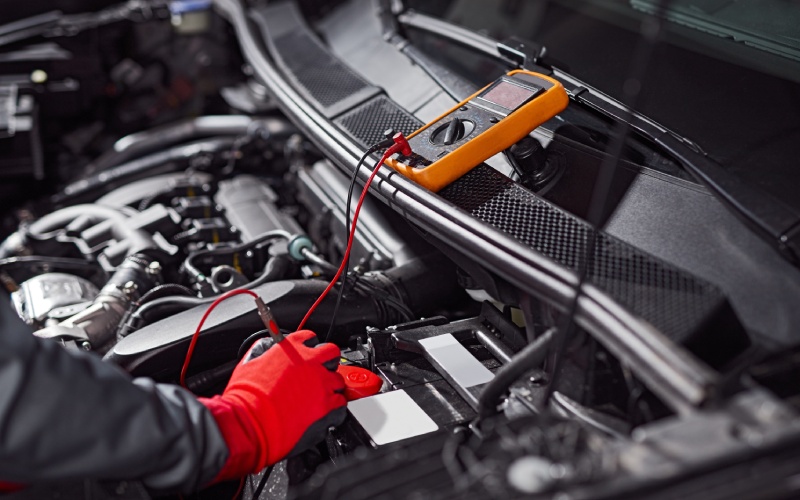
A proper diagnosis starts with confirming battery health. A weak or sulfated battery can mimic a drain, so pros load-test it first and verify clean, tight terminals. Next comes measuring key-off current with an ammeter or amp-clamp. Because many vehicles wake up when a door opens, seasoned techs use protected access points, maintain memory power, and let the network time out so modules can go to sleep. If the draw remains high, the classic method is a controlled fuse-pull test while watching current. When the draw drops, the problem circuit is identified, and we move downstream—checking connectors, switches, and components on that branch. For complex cases, a lab scope monitors current over time to catch periodic wake-ups caused by software or a failing module.
It is just as important to prevent collateral damage during testing. Battery-saver tools, stable power supplies for software resets, and careful handling of airbag and high-voltage components keep you safe and preserve the vehicle’s memory settings. Once the fault is corrected—maybe a sticky relay, a miswired dash cam, or a water-damaged liftgate switch—the final step is validation. That means confirming the draw returns to normal, the car sleeps consistently, and it restarts after typical overnight sits.
When you are ready for help, you want a straightforward plan and results you can trust. Our team uses repeatable methods, documents readings, and explains each step so you know exactly what was fixed and why. That is how parasitic drains go from chronic headaches to solved problems that stay solved.
Frequently Asked Questions:
How much key-off current is normal?
Most late-model vehicles settle between 20 and 50 milliamps once all modules sleep, though some systems take up to 30 minutes to reach that state. We compare your reading to OEM data and real-world experience for your platform.
Can a new battery hide a parasitic drain?
Temporarily, yes. A strong battery may mask the issue for days or weeks. As it ages, the same drain reappears. Proper testing confirms the draw instead of relying on a short-term bandage.
Will driving more fix the problem?
Longer drives can recharge a healthy battery, but they will not cure a component that will not sleep or a stuck relay. The root cause needs correction to prevent repeat failures.
Do aftermarket remote starters always cause drains?
No, when installed correctly on switched power with proper integration, they can work fine. Many drains come from constant-power taps or poor grounding. Quality installation and wiring practices make the difference.
Is pulling fuses safe to do at home?
Intermittently, yes—but you can wake modules or set fault codes unintentionally. If you try it, use the correct fuse chart and avoid airbag or high-voltage circuits. A professional approach is safer and more conclusive.
When a parasitic drain starts stealing your morning, it pays to get systematic. Matt Blatt Tire and Auto uses proven test methods to isolate the exact cause, verify the fix, and confirm that your vehicle sleeps properly again. With our team serving Monroe, Williamstown, and Sewell, you can count on a quick path from dead-battery mystery to everyday dependability—backed by clear documentation and a focus on protecting your vehicle’s electronics.
