

Matt Blatt Tire and Auto - Is it safe to drive with an exhaust leak? - What Pitman, NJ Drivers Should Know
Safety and engine health should always come first when you suspect an exhaust issue, especially if you live or commute near Pitman, NJ. Between short in-town trips on Broadway, seasonal road salt from winter storms, and frequent construction detours around Route 55 and Delsea Drive, exhaust components can rust, crack, or loosen faster than many drivers expect. At Matt Blatt Tire and Auto in nearby Glassboro, our AAA-Approved Auto Repair Facility is equipped to diagnose exhaust problems accurately and fix them the right way so you can drive with confidence.
The straightforward truth is that driving with an exhaust leak is not safe. Fumes can enter the cabin, engine sensors can be thrown off, the catalytic converter can be damaged by excess heat or unburned fuel, and your vehicle may produce excessive noise that draws unwanted attention. If you notice exhaust smells, a louder-than-normal rumble, or a ticking noise at cold start, it’s time to act. Below, we’ll explain why exhaust leaks matter, how to spot them, what to do next, and how our team helps Pitman drivers get back on the road quickly and safely.
Let’s start with what makes exhaust leaks risky from both a safety and performance standpoint. Exhaust routing is designed to move hazardous gases away from the cabin, quiet engine noise, and keep back-pressure within a healthy range so the engine breathes correctly. When a pipe, flex joint, gasket, or muffler fails, the system can’t contain or direct gases as intended. That can allow carbon monoxide to seep into the cabin, reduce catalytic converter efficiency, create false air readings at the oxygen sensors, and ultimately lead to poor fuel economy and sluggish acceleration. Left alone, a small leak often grows into a larger repair.
Because Pitman drivers often mix short commutes with weekend drives to Alcyon Lake or quick runs across town, the exhaust system rarely gets hot enough to evaporate condensation on short trips. That leftover moisture accelerates internal rust in mufflers and pipes. Add in winter salt and occasional contact with speed bumps or driveway aprons, and even a solid exhaust can develop weak points over time. Keeping an eye—and ear—on a few telltale signs will help you address issues early.
Here are the most common symptoms that suggest an exhaust leak or failing component is developing.
- Louder exhaust note: A deep rumble or sudden growl during acceleration often points to a leak at the muffler, mid-pipe, or tailpipe.
- Ticking at cold start: A sharp tick that softens as the engine warms can signal a cracked manifold or a leaking exhaust gasket.
- Exhaust odor in cabin: Any fumes inside—especially with windows up—demand immediate attention for your safety.
- Visible rust, soot, or broken hangers: Black soot near joints, flanges, or shields, and drooping pipes often indicate leaks or failing supports.
- Reduced power or fuel economy: Incorrect backpressure and sensor readings can hurt performance and mileage.
- Illuminated check engine light: Faults related to oxygen sensors or catalytic converter efficiency can be triggered by leaks upstream.
If any of the above sound familiar, minimizing drive time and getting a professional inspection is the safest move. The good news is that most exhaust issues are straightforward to confirm once your vehicle is on a lift, and many can be repaired before they cascade into broader engine or emissions problems.
At Matt Blatt Tire and Auto, we use a methodical process to verify where the leak originates and why it happened. This ensures we address the root cause—not just the symptom—so you’re not back in the bay for the same issue later.
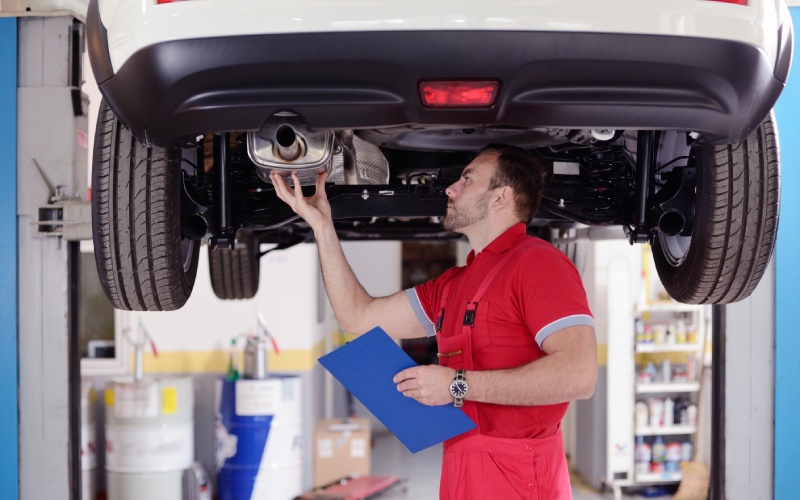
- Lift-and-light inspection: We examine pipes, flanges, flex joints, heat shields, the muffler and resonator, and the catalytic converter for rust, cracks, or impact damage.
- Hanger and mount check: Broken or stretched hangers allow excessive movement that can split welds or stress flex sections.
- Gasket and flange review: Donut and manifold gaskets are common leak points—especially after thermal cycling or minor impacts.
- Sensor and wiring validation: Oxygen sensor function and harness integrity are verified to protect engine performance and emissions.
- Targeted leak testing: Depending on the situation, we may perform smoke or sound tracing to pinpoint small leaks that aren’t obvious at idle.
- Backpressure and data assessment: We evaluate exhaust flow and scan data to ensure the catalytic converter isn’t restricted or being harmed by the leak.
Once we’ve identified the exact cause, we’ll explain your options clearly and recommend a durable fix. As a Goodyear Tire & Service Network location, and with more than 30 years serving Glassboro, Pitman, Sewell, and Mullica Hill, our team services all makes and models and proudly honors most extended warranties. Whether you drive a compact commuter, a family SUV, or a work truck that sees daily miles along Delsea Drive, we’ll match the repair to your vehicle’s needs and your driving environment.
If you’re concerned right now about a suspected exhaust leak, a few immediate steps can help reduce risk while you arrange service.
- Limit driving and avoid idling in enclosed spaces like garages.
- Crack windows open to increase ventilation if you must drive briefly.
- Turn off recirculation so fresh air flows through the cabin.
- Schedule an inspection with our team as soon as possible.
- If you feel lightheaded or drowsy, pull over safely and seek fresh air right away.
Nearby roads and weather can influence how quickly exhaust parts wear out, so it helps to plan ahead. In Pitman, winter salt and frequent short trips accelerate internal corrosion; summer heat expands metal and can finish off marginal gaskets. If you regularly navigate speed bumps, steep driveways, or gravel surfaces, flex pipes and hangers deserve extra attention at each oil change. We’ll keep an eye on these high-wear items during routine visits so small issues are caught before they affect safety or drivability.
Choosing Matt Blatt Tire and Auto means choosing a shop that stands behind the work and values transparency. Our AAA-Approved Auto Repair Facility standards guide every inspection and repair, and our advisors take the time to explain what we found and why it matters. We’re conveniently located at 1210 Delsea Drive N in Glassboro—just minutes from Pitman—and we’re open Monday through Friday 8am to 5pm and Saturday 8am to 4pm. If an extended warranty applies to your exhaust repair, we’ll help with the process so your visit is as smooth as possible.
While many exhaust issues are repairable with targeted fixes—like replacing a failed gasket, flex pipe, or muffler—others require more comprehensive service. Corroded pipes can compromise multiple sections at once, and severely rusted flanges may not seal correctly without replacement. Our goal is to give you a repair path that lasts, meets emissions requirements, and keeps cabin air fresh and safe for your daily drives through Pitman and beyond.
Not sure if the sound you hear is truly exhaust-related? Our team can differentiate between exhaust noise, wheel bearing hum, heat shield rattle, or engine tick quickly. Clear diagnosis is your fastest route to a correct fix—and to getting back to your routine with confidence.
When you’re ready, give us a call at (856) 218-7930 or schedule service online. From quick checks to complete exhaust system repairs, we’re here to help you breathe easy and drive safely—whether you’re commuting to Route 55, shuttling to schools around Pitman, or heading out for a weekend along the South Jersey shore roads.
Frequently Asked Questions:
Can I drive a short distance with an exhaust leak?
It’s best to avoid driving, even for short trips. Exhaust gases can enter the cabin quickly, especially with windows closed. If you must move the vehicle briefly, increase ventilation, avoid idling, and schedule an inspection immediately.
What causes exhaust leaks around Pitman, NJ?
Common local contributors include winter road salt, repeated short trips that leave moisture inside the system, contact with speed bumps and steep driveways, and rust-prone flanges or hangers. Over time, these factors weaken pipes, gaskets, and welds.
Will an exhaust leak damage my catalytic converter?
Yes—leaks upstream of the catalytic converter can alter oxygen sensor readings, leading to rich or lean conditions that overheat or contaminate the converter. Prompt repair helps protect the catalytic converter and maintain proper emissions.
How does Matt Blatt Tire and Auto diagnose exhaust issues?
We combine a lift inspection with targeted tests as needed—checking hangers and flanges, assessing sensor data, verifying backpressure, and using smoke or sound tracing to locate hard-to-find leaks. Then we review options with you before any work begins.
Do you honor extended warranties and service all makes and models?
Absolutely. We honor most extended warranties and service all makes and models. As an AAA-Approved Auto Repair Facility and a Goodyear Tire & Service Network location, we back our work and focus on long-lasting, safety-first repairs.
For trusted exhaust system repair near Pitman, NJ, count on Matt Blatt Tire and Auto to provide clear answers, thorough inspections, and reliable repairs that keep you safe and your vehicle performing at its best.
